
- Why EVs Demand a Different Tyre
- Sustainability Strategy and Goals
- Rolling Resistance and Range Extension
- Sustainable Materials in EV Tyres
- Smart Tyres and Lifecycle Optimisation
- India Market: EV Tyre Sustainability
- Progress vs. Target Tracker
- Key Sustainability Innovations and Technologies
- Measurable Impacts
- Challenges and Areas for Improvement
- Future Plans and Long-Term Goals
- Comparisons to Industry Competitors
- What to Watch: 12 to 18 Month Indicators
The EV tyre market is one of the fastest-growing segments in the automotive supply chain, valued at USD 36.30 billion in 2025 and projected to reach USD 337.20 billion by 2034, expanding at a CAGR of 28.10%. This growth is driven by a fundamental incompatibility between conventional tyre design and the unique mechanical demands of electric vehicles, which forces a full rethink of materials science, tread architecture, noise management, and end-of-life responsibility.
Why EVs Demand a Different Tyre
EVs carry lithium-ion battery packs weighing between 300 kg and 900 kg, making them 20 to 30% heavier than equivalent internal combustion engine vehicles. This additional mass increases contact stress on the tread surface, and combined with the instant torque delivery at low speeds that defines EV driving dynamics, accelerates tyre wear by 20 to 50% compared to conventional vehicles.
For every 1,000 pounds of additional vehicle weight, tyre wear increases by 20%, according to research by Emissions Analytics. This creates three compounding sustainability consequences:
- Higher TRWP emissions per kilometre driven, directly contradicting the clean mobility narrative of electrification
- Shorter tyre replacement cycles, generating more end-of-life tyre waste per vehicle per year
- Greater demand for silent tread compounds, since EVs have no combustion engine to mask road noise, making tyre-generated cabin noise the dominant acoustic concern
Source
https://www.precedenceresearch.com/electric-vehicle-tire-market
https://www.automotiveworld.com/articles/inside-the-not-so-hidden-issue-of-higher-tyre-usage-in-evs/
https://www.vajiraoinstitute.com/upsc-ias-current-affairs/tyre-particles-how-ev-are-a-climate-solution-with-a-pollution-problems
https://www.designnews.com/automotive-engineering/the-silent-innovation-behind-ev-tires
Sustainability Strategy and Goals
EV tyre sustainability sits across five engineering and commercial domains: rolling resistance optimisation (for range extension), material circularity (bio-based and recycled inputs), TRWP reduction (for microplastic compliance), acoustic management (for cabin quality), and smart monitoring (for lifecycle efficiency). No single tyre currently leads on all five dimensions.
Rolling Resistance and Range Extension
Rolling resistance is the most commercially prioritised sustainability metric in EV tyres because it directly affects battery range, the primary EV purchase anxiety. The global low rolling resistance tyre (LRRT) market for EVs was valued at USD 15 billion in 2025 and is projected to reach USD 45 billion by 2033 at a 12% CAGR, driven by regulatory fuel efficiency mandates and consumer range expectations.
- Michelin’s e.Primacy All-Season tyre, launched February 2025, is up to 25% more energy-efficient than competitors, extends EV range by up to 32 km (20 miles), and lasts up to 21,000 km (13,000 miles) longer.
- The Michelin Pilot Sport EV uses GreenPower Compound for low energy consumption and Piano Acoustic Technology for noise reduction, directly addressing the EV-specific acoustic gap.
- Continental’s EcoContact 7 achieved EU label grade A for rolling resistance, reducing energy consumption measurably for BEV applications.
- Bridgestone’s Turanza Eco tyre, built on the ENLITEN platform, claims the lowest rolling resistance in its category, saving up to 0.21 litres per 100 km and extending EV range by 7%, while maintaining performance past 30,000 km.
Source
https://www.datainsightsmarket.com/reports/low-rolling-resistance-tires-for-ev-129328
https://www.marketsandmarkets.com/ResearchInsight/electric-vehicle-tires-market.asp
https://recharged.com/articles/best-low-rolling-resistance-tires-for-electric-cars
https://evmagazine.com/top10/top-10-ev-tyres
Sustainable Materials in EV Tyres
EV tyre manufacturers are accelerating bio-based and recycled material integration, driven by both EU regulatory pressure and OEM sustainability procurement requirements. The shift away from petrochemical inputs is most advanced in silica compounds, polyester cords, and carbon black.
- Bridgestone’s Turanza EV tyre (2023) uses approximately 50% renewable and recycled materials, including natural rubber and recycled polymer blends.
- Continental increased its renewable and recycled material share from 26% in 2024, targeting 40%+ by 2030, using ISCC PLUS-certified inputs including recycled PET polyester, rice-husk-ash silica, and recycled steel.
- Goodyear unveiled the ElectricDrive Sustainable-Material (EDS) tyre at the China International Import Expo in November 2024, featuring ISCC-certified recycled polyester and carbon black, designed for exceptional wet braking, reduced noise, lower rolling resistance, and long lifespan.
- Emerging polymer science published in December 2025 confirmed that bio-based polymer compounds and advanced silica dispersions are transforming the EV tyre industry, with smart sensors and closed-loop manufacturing techniques reshaping both performance and sustainability metrics simultaneously.
Source
https://www.marknteladvisors.com/research-library/electric-vehicle-tire-market-gcc.html
https://www.marketsandmarkets.com/ResearchInsight/electric-vehicle-tires-market.asp
https://finance.yahoo.com/news/electric-vehicles-revolutionizing-tires-sustainable-104013670.html
Smart Tyres and Lifecycle Optimisation
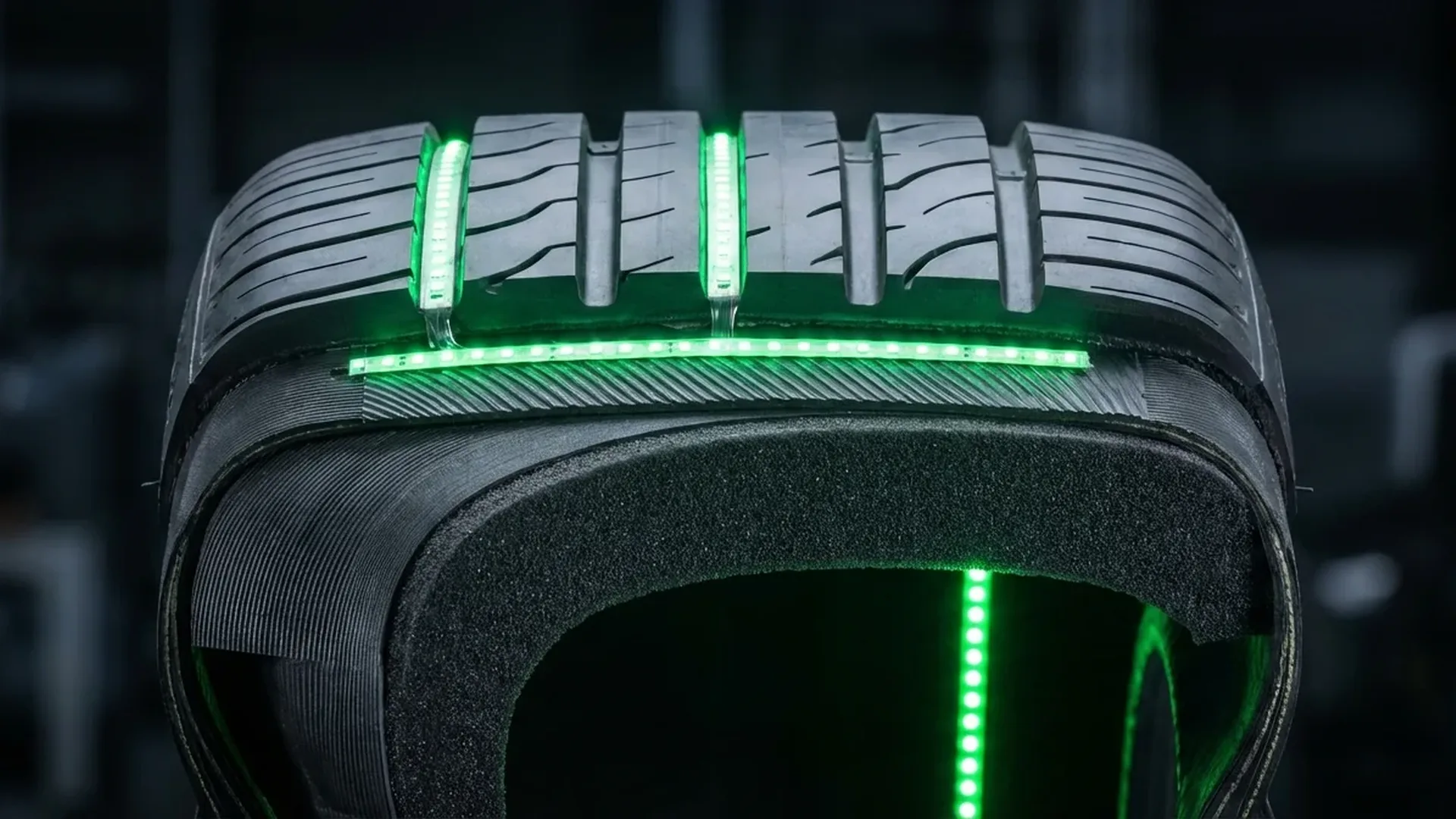
Smart tyre technology addresses the sustainability gap that material innovation alone cannot close: premature wear from incorrect inflation, misalignment, and undetected mechanical stress. RFID chips and embedded pressure and temperature sensors are becoming standard on commercial EV fleets, enabling predictive maintenance that extends tyre life and reduces TRWP emissions per kilometre.
- Smart tyre pressure management directly extends range in EVs, where every unit of rolling resistance translates to measurable battery drain.
- AI-powered wear pattern tracking identifies alignment issues and abnormal wear before visible tread degradation, reducing the number of replacement cycles per vehicle.
- Blockchain-based performance monitoring and embedded sensor data are being used by fleet operators to verify sustainability claims at the individual tyre level, supporting Scope 3 emissions accounting.
- The Goodyear EDS tyre integrates sensor-ready architecture with sustainable material inputs, positioning it as a platform product for both sustainability and digital fleet management.
Source
https://www.ceatspecialty.com/in/blog/industry/tyre-industry-trends-for-2025-innovations-and-market-shifts
https://trojanlimited.com/top-25-tyre-manufacturers-in-the-world-2025-production-volumes-capacity-revenue-strategic-insights/
https://www.tyredispatch.co.nz/blogs/news/smart-tyres-nz-2025-the-complete-guide-to-connected-tyre-technology
India Market: EV Tyre Sustainability
India’s EV tyre market is on a trajectory that makes it a critical growth arena for sustainable product development. The market was valued at USD 479.64 million in 2024 and is expected to reach USD 1,063.93 million by 2030 at a CAGR of 14.20%. In volume terms, the market grew from 8.39 million units in 2024 and is projected to reach 48.39 million units by 2030 at a CAGR of 32.04%, reflecting accelerating unit penetration alongside value growth.
- EV sales in India grew 150% in 2023, directly increasing demand for EV-specific tyres.
- By 2030, 25% of India’s tyre market is expected to be dedicated to EV-specific tyres.
- India’s government target of 30% EV share of total vehicle sales by 2030 creates a policy-mandated demand floor for EV tyre manufacturers.
- India’s overall tyre market is expected to grow from INR 57,000 crore in 2020 to INR 74,000 crore by 2026, with EV-specific tyres contributing a growing share of that expansion.
Source
https://www.techsciresearch.com/report/india-ev-tyre-market/28836.html
https://www.marknteladvisors.com/research-library/india-electric-vehicle-tire-market.html
https://www.linkedin.com/pulse/future-proofing-tyre-industry-how-evs-sustainability-itzoc
Progress vs. Target Tracker
Source
https://www.marknteladvisors.com/research-library/electric-vehicle-tire-market-gcc.html
https://www.marketsandmarkets.com/ResearchInsight/electric-vehicle-tires-market.asp
https://recharged.com/articles/best-low-rolling-resistance-tires-for-electric-cars
https://blackdonuts.com/2025/08/12/euro7-tire-abrasion-compliance/
Key Sustainability Innovations and Technologies
Five innovations are defining the technical frontier for EV tyre sustainability through 2030:
- ENLITEN platform (Bridgestone): A proprietary technology architecture combining lighter casing construction, lower rolling resistance compounds, and renewable material integration. Applied to the Turanza Eco and Turanza EV product lines, it enables Bridgestone to serve both premium OEM EV fitments (Porsche Macan Electric, Panamera) and mass-market fleet operators.
- GreenPower Compound (Michelin): Michelin’s compound formulation used across its EV-specific range achieves lower hysteresis in the rubber matrix, reducing the energy lost as heat during tyre deformation. Combined with Piano Acoustic Technology for noise reduction, it directly addresses the two primary EV-specific performance gaps.
- Airless tyre development: Michelin’s UPTIS (Unique Puncture-Proof Tire System) and equivalent programmes at other manufacturers eliminate blowout risk, extend tyre lifespan, and remove the need for spare tyres, reducing total material per vehicle lifecycle. No commercial deployment at scale had been confirmed for EVs as of March 2026.
- Recycled carbon black and ISCC-certified inputs: Goodyear’s EDS tyre uses ISCC-certified sustainable carbon black and recycled polyester in its commercial EV formulation, establishing a supply chain certification standard that other manufacturers are expected to follow as procurement requirements tighten.
- Embedded sensor and AI wear monitoring: Smart tyre architecture being integrated into premium EV tyres enables real-time pressure, temperature, and load data to feed fleet management systems, reducing abnormal wear events and extending replacement intervals.
Source
https://recharged.com/articles/best-low-rolling-resistance-tires-for-electric-cars
https://www.marketsandmarkets.com/ResearchInsight/electric-vehicle-tires-market.asp
https://www.reportlinker.com/article/6642
https://finance.yahoo.com/news/electric-vehicles-revolutionizing-tires-sustainable-104013670.html
Measurable Impacts
The scale of the EV tyre sustainability transition is best understood through market volume, not just material percentage data. The global EV tyre market will grow from USD 36.30 billion in 2025 to USD 337.20 billion by 2034. That means the absolute quantity of EV tyres manufactured and replaced will increase by roughly 9x within a decade, making material composition decisions made today structurally embedded in the global TRWP and waste stream for decades.
- Tyre wear mass in road tests is up to 1,850 times higher than exhaust particle mass for modern low-emission cars, confirming that electrification shifts the pollution profile rather than eliminating it.
- By 2050, an estimated 90% of particulate emissions from road transport in Europe will originate from non-exhaust sources, predominantly tyres and brakes, up from a minority share in 2020.
- Bridgestone’s Turanza Eco maintains verifiable performance past 30,000 km, directly reducing replacement frequency and the per-vehicle ELT generation rate relative to conventional tyres.
- India’s EV tyre volume is projected to grow from 8.39 million units in 2024 to 48.39 million units by 2030, meaning India alone will add approximately 40 million EV tyres annually to global waste and TRWP flows.
Source
https://recharged.com/articles/ev-tire-pollution
https://www.pew.org/en/about/news-room/press-releases-and-statements/2024/03/14/pew-applauds-eus-first-of-its-kind-legislation-to-tackle
https://evmagazine.com/top10/top-10-ev-tyres
https://www.techsciresearch.com/report/india-ev-tyre-market/28836.html
Challenges and Areas for Improvement
The central contradiction in EV tyre sustainability is that the clean vehicle transition directly increases tyre wear pollution. The 20 to 50% higher wear rate of EV tyres means that each EV contributes more TRWP per kilometre than an equivalent ICE vehicle, producing more microplastics, more frequent end-of-life tyre events, and more demand for raw materials, even when those materials are renewable. No manufacturer has published a quantified TRWP reduction target specific to their EV tyre product line as of March 2026.
The acoustic engineering challenge creates material trade-offs. Foam inserts and specialised tread patterns for noise reduction add complexity to recycling and end-of-life processing. Foam-lined tyres, used by multiple OEMs as standard fitments on EVs, are more difficult to process in conventional tyre recycling streams because the foam layer must be separated before rubber recovery can begin.
Commercial production scale for sustainable EV tyre materials remains a constraint. ISCC-certified recycled carbon black and bio-based polymers are available at the formulation level but not yet at the supply volumes required to meet projected EV tyre demand growth of 28.10% annually. The gap between material science prototype performance and industrial-scale procurement is the most significant execution risk for manufacturers with 2030 sustainable material targets.
Source
https://www.automotiveworld.com/articles/inside-the-not-so-hidden-issue-of-higher-tyre-usage-in-evs/
https://www.designnews.com/automotive-engineering/the-silent-innovation-behind-ev-tires
https://www.precedenceresearch.com/electric-vehicle-tire-market
Future Plans and Long-Term Goals
The sustainable EV tyre market is projected to grow from USD 143.59 billion in 2025 to USD 189.47 billion by 2031 for passenger car green tyres globally. Long-term product roadmaps across major manufacturers converge on three outcomes: tyre compounds with 50 to 70% recycled and renewable material content by 2030, airless or extended-life designs that reduce replacement frequency and ELT volumes by 2035, and fully circular tyre design enabled by chemical recycling and material recovery by 2040 to 2050.
On the regulatory side, Euro 7 abrasion limits for passenger cars are due by June 2026 and for heavy vehicles by 2030. These will set binding abrasion rate thresholds that will force reformulation across all EV tyre product lines regardless of whether manufacturers lead or follow. The integration of AI and embedded sensor data into tyre lifecycle management will advance from fleet applications to individual consumer products between 2026 and 2030, creating a real-time data layer that supports both sustainability claims and regulatory compliance.
Source
https://finance.yahoo.com/news/passenger-car-green-tire-market-143900398.html
https://www.futuremarketinsights.com/reports/ev-tires-market
https://blackdonuts.com/2025/08/12/euro7-tire-abrasion-compliance/
Comparisons to Industry Competitors
Competitor sustainability reports:
https://www.michelin.com/en/sustainability/company
https://www.bridgestone.com/responsibilities/esgdata/
https://corporate.goodyear.com/content/dam/goodyear-corp/documents/responsibility/goodyear-crr-2024-final.pdf
https://www.marketsandmarkets.com/Market-Reports/electric-vehicle-tires-market-219022969.html
What to Watch: 12 to 18 Month Indicators
Three developments between now and mid-2027 will define whether EV tyre sustainability advances structurally or remains fragmented across product lines:
- Euro 7 passenger car abrasion limits (June 2026 confirmation deadline): Binding tyre abrasion limits for passenger cars are targeted for agreement by June 2026 under the EU’s Euro 7 framework. For EV tyres specifically, these limits carry greater commercial consequence than for ICE vehicles because EV tyres already wear 20 to 50% faster, meaning reformulation requirements will be deeper and more costly. Any confirmed threshold will immediately trigger specification changes across OEM supply agreements and accelerate investment in low-abrasion compound development.
- Goodyear EDS tyre commercial launch timeline: Goodyear unveiled the EDS tyre prototype at the China International Import Expo in November 2024 with a stated 100% sustainable material ambition by 2030. A confirmed commercial launch date and volume production supply chain announcement in 2026 to 2027 would establish whether this prototype translates into a deployable product, or remains an innovation demonstration while competitors close the material content gap independently.
- India EV tyre market infrastructure development: India’s EV tyre market is growing at 32.04% CAGR toward 48.39 million units by 2030. Whether domestic manufacturers, led by MRF, CEAT, and Apollo, deploy EV-specific sustainable tyre formulations in the mass market, or whether imported premium EV tyres dominate the sustainable segment, will determine the per-kilometre TRWP footprint of India’s EV transition, one of the largest in the world.
Source
https://blackdonuts.com/2025/08/12/euro7-tire-abrasion-compliance/
https://www.marketsandmarkets.com/ResearchInsight/electric-vehicle-tires-market.asp
https://www.marknteladvisors.com/research-library/india-electric-vehicle-tire-market.html
EV tyres are the most commercially urgent sustainability challenge in the tyre industry right now. The market is growing at 28.10% annually, the regulatory timeline is fixed, and the core contradiction of EVs generating more TRWP per kilometre than ICE vehicles is documented but not yet priced into most ESG assessments of EV adoption. The clean transport narrative requires a material correction.
Bridgestone’s 50% recycled and renewable material benchmark in the Turanza EV is the most credible commercial milestone in the segment. Continental’s trajectory from 26% in 2024 toward 40%+ by 2030 is on track but incremental. Michelin’s range extension performance leadership is commercially powerful but does not address TRWP. No manufacturer leads on all dimensions simultaneously.
Three strategic takeaways for practitioners:
- Separate range efficiency claims from sustainability claims in EV tyre procurement: A tyre that extends EV range by 32 km reduces charging frequency and Scope 2 emissions at the fleet level. It does not reduce TRWP, which is generated per kilometre regardless of energy efficiency. Procurement scorecards must track both dimensions independently.
- Build EV tyre replacement cycle data into fleet ESG accounting: EV tyres lasting 20 to 50% fewer kilometres than conventional tyres means each vehicle generates proportionally more ELT waste annually. Fleet operators must include accelerated tyre replacement cycles in their Scope 3 material consumption and waste reporting to avoid systematic underestimation of EV fleet environmental impact.
- Engage India-market suppliers now, before regulatory catch-up: India’s EV tyre market will add approximately 40 million units annually by 2030, largely outside current Euro 7 and EU REACH microplastics frameworks. Multinational corporations with Indian EV fleets or supply chains face a regulatory arbitrage risk where TRWP volumes grow unchecked until Indian regulation catches up. Proactive supplier engagement on tyre specification standards in India reduces that forward liability.