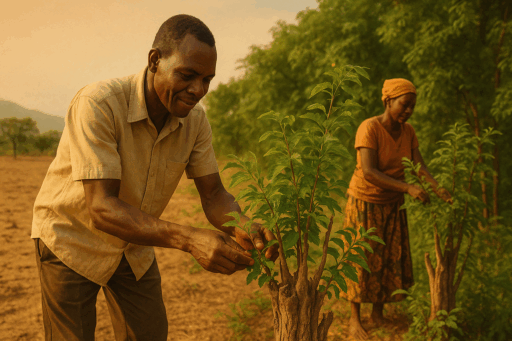
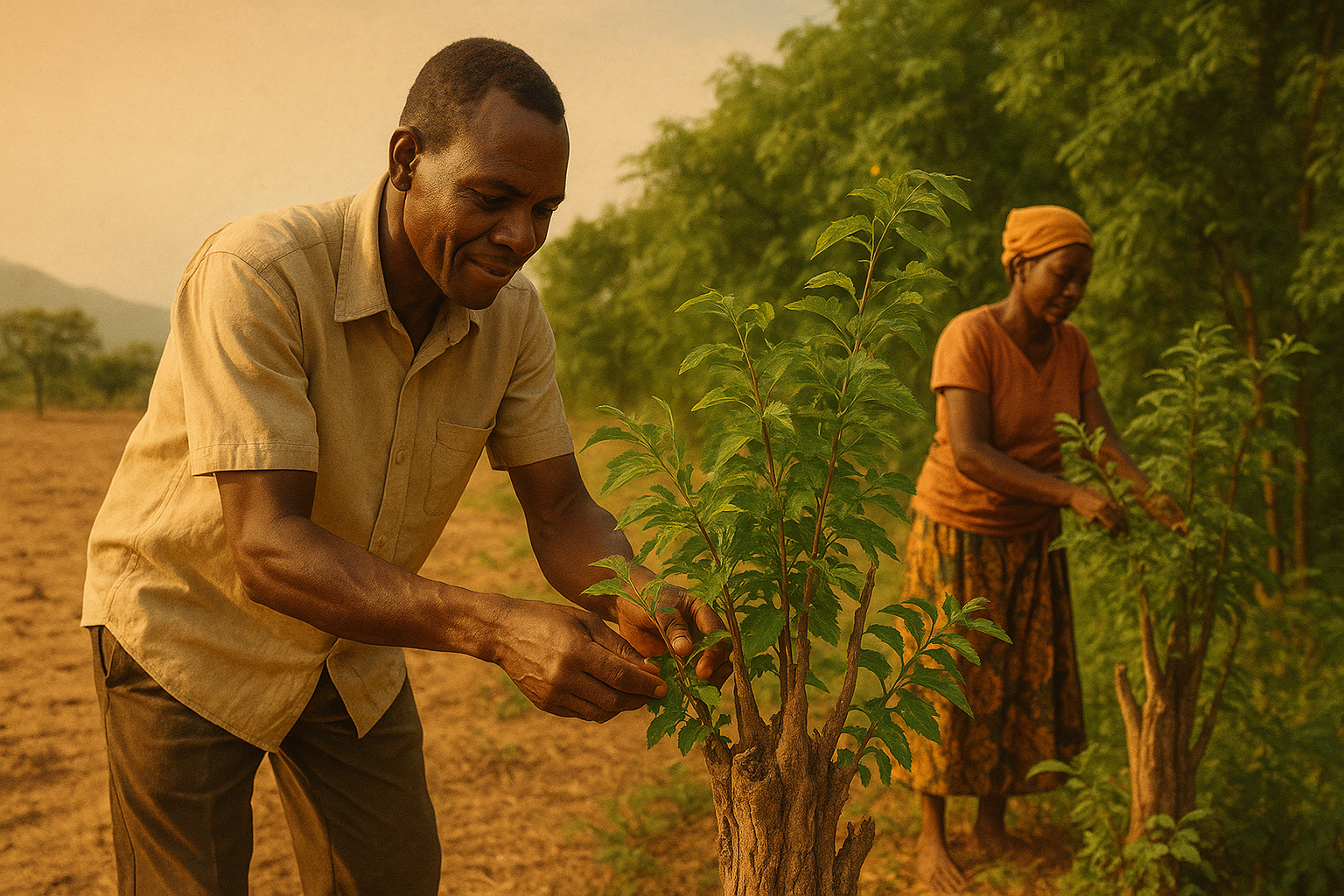

Kisiki Hai, meaning “living stump” in Swahili, is the local name for Farmer Managed Natural Regeneration (FMNR) used widely in Tanzania and across the Sahel. It is a farmer-led natural resource management system where farmers protect and prune shoots from existing stumps and root systems instead of planting new trees. This transforms low-cost on-farm tree management into a powerful climate, livelihoods, and land-restoration strategy. FMNR / Kisiki Hai is now a core pillar of large restoration programs run by World Vision, Justdiggit, LEAD Foundation, and Regreening Africa, and is increasingly referenced as a scalable model under the UN Decade on Ecosystem Restoration.
- In Niger, FMNR expanded over roughly 20 years to cover about 5–6 million hectares of farmland, increasing tree density from around 4 trees per hectare to over 40 and regenerating an estimated 200 million trees.
- In Tanzania’s Dodoma region, Kisiki Hai has helped mobilize more than 110,000 farmers to regenerate over 6.3 million trees on farmland as part of the Regreening Dodoma program.
- These interventions in Dodoma are estimated to help the landscape retain around 4 billion liters of water annually, improving microclimates and drought resilience.
- Across catalyst countries supported by World Vision, FMNR has influenced millions of hectares in Ethiopia, Kenya, Niger, and others, with national programs now planning long-term scale-up.
Video: Kisiki Hai in action
The video “We grew a forest WITHOUT planting a single tree” illustrates how farmers can regenerate trees and restore forests by managing what is already in the soil – exactly the principle behind Kisiki Hai / FMNR. It is an accessible way to introduce decision-makers, extension agents, and corporate sustainability teams to the logic of farmer-managed natural resource restoration.
- FMNR approaches like Kisiki Hai have helped regenerate about 200 million trees in Niger alone, demonstrating the core message of forest recovery without conventional tree planting.
- The technique is now used in at least 40 countries and is highlighted by global restoration initiatives as one of the fastest, farmer-driven ways to restore tree cover in drylands.
- Programs using Kisiki Hai / FMNR commonly report increases in crop yields, fodder availability, and resilience to climate shocks, making the approach highly relevant for climate-risk management portfolios.
Sustainability Strategy and Goals
Although Kisiki Hai is not a company, it is embedded in structured strategies led by NGOs, governments, and alliances such as Regreening Africa, AFR100, and the Great Green Wall. These actors frame Kisiki Hai as a practical pathway towards UN SDGs 2, 13, and 15, Land Degradation Neutrality, and Paris-aligned climate targets. The core “strategy” behind Kisiki Hai is to regenerate multi-functional tree cover on farms and rangelands, thereby reducing net emissions (Scope 3 for value-chain buyers), improving water stewardship, enabling regenerative agriculture, and protecting biodiversity while strengthening smallholder rights and livelihoods. In many landscape programs, FMNR is combined with soil and water conservation, farmer organizations, and digital monitoring, creating a holistic natural resource management system rather than a standalone practice.
Within that broader strategy, Kisiki Hai contributes to key themes:
- Net Zero and Carbon Emissions: Trees regenerated through Kisiki Hai store carbon in biomass and soils; at landscape scale, FMNR is considered a cost-effective nature-based solution that can complement science-based corporate targets. For example, the Great Green Wall aims to restore 100 million hectares, sequester 250 million tonnes of carbon, and create 10 million rural jobs by 2030—FMNR-type approaches are central to how that restoration is delivered in drylands.
- Water Stewardship and Soil Health: By increasing tree cover, Kisiki Hai improves infiltration, reduces wind erosion, and enhances soil organic matter. In Dodoma, Kisiki Hai and related techniques help retain an estimated 4 billion liters of water annually in the landscape.
- Regenerative Agriculture, Nutrition, and Livelihoods: Regenerated trees provide leaf litter, shade, and root systems that raise soil fertility and stabilize yields. In Niger, FMNR is associated with an extra 500,000 tons of grain production per year, supporting around 2.5 million people—critical for food and nutrition security.
- Deforestation, Biodiversity, and Human Rights: By supplying fuelwood, fodder, and timber directly from farms, Kisiki Hai reduces pressure on remaining forests and protects habitats, while diversifying income sources for smallholders—many of them women. Regreening Africa’s first phase reached more than 607,000 households and helped increase average tree density on targeted land from 43 to 120 trees per hectare.
- Governance, Transparency, and Global Partnerships: Kisiki Hai is promoted through multi-stakeholder coalitions like AFR100, where 34 African countries have committed to restore at least 100 million hectares of degraded land by 2030, often with FMNR as a core method.
Key Sustainability Innovations and Technologies
Kisiki Hai is deceptively simple but innovative: instead of importing seedlings, farmers “discover” the underground forest of stumps and roots already present, then selectively prune and protect shoots to grow back a multi-purpose tree layer. This transforms tree regeneration into a behavioral and governance innovation rather than a hardware-heavy planting project. Programs in Tanzania and the Sahel integrate Kisiki Hai with climate-smart water harvesting (bunds, contour trenches), participatory land-use planning, and increasingly with digital tools like mobile-based training, remote sensing, and monitoring platforms for trees and carbon. Justdiggit’s “Treecovery” approach in Tanzania brands Kisiki Hai as a scalable technique, supported by mass communication campaigns and farmer-to-farmer training.
- In Dodoma’s Regreening program, over 110,000 farmers have been mobilized to regenerate more than 6.3 million trees, demonstrating how a simple pruning technique can scale rapidly with the right training and communication.
- Regreening Africa’s multi-country program reports that its regreening practices (including FMNR) helped restore over 350,000 hectares, with tree density increasing from 43 to 120 trees per hectare on treated land—evidence of landscape-level impact.
- FMNR field manuals now codify step-by-step technical guidance (stump selection, shoot thinning, pruning cycles, community bylaws), enabling rapid replication by governments, NGOs, and private partners in more than 27 countries.
- The Regreening Dodoma initiative is planning a 17-year “sustainability phase” to ensure that the Kisiki Hai trees and local institutions (such as farmer committees and village regulations) continue to function beyond project cycles – an important governance innovation.
Measurable Impacts
For sustainability and ESG teams, Kisiki Hai’s value lies in the fact that its impacts are both measurable and multi-dimensional: carbon, soil health, water, biodiversity, and livelihoods all shift in a positive direction when tree cover returns to degraded smallholder landscapes. Long-term studies in Niger, Tanzania, and Ethiopia show that FMNR improves yields, stabilizes production in drought years, and generates new income streams from wood, fodder, and non-timber tree products—effects that can be mapped against climate and nature-related disclosures (CSRD, TCFD, TNFD) and Scope 3 footprints in agricultural supply chains.
- In Niger, FMNR over roughly 20 years restored about 5 million hectares of farmland, increased average tree density from 4 to more than 40 trees per hectare, and regenerated approximately 200 million trees; this is associated with an additional 500,000 tons of grain each year, benefiting around 2.5 million people.
- The Regreening Dodoma program reports 6.3 million trees regenerated and improved water retention of around 4 billion liters annually, indicating tangible hydrological and microclimate benefits that are critical for adaptation metrics.
- Regreening Africa phase one reached over 607,000 households and contributed to regreening more than 350,000 hectares, with tree density on treated land nearly tripling from 43 to 120 trees per hectare.
- In Ethiopia and other FMNR “catalyst countries,” national programs target millions of hectares for FMNR scale-up, recognizing it as a key tool for reversing severe land degradation and meeting restoration pledges under AFR100 and the Bonn Challenge.
Challenges and Areas for Improvement
Despite impressive results, Kisiki Hai operates in landscapes facing structural pressures: insecure land tenure, poverty, climate volatility, and limited extension capacity. In many parts of sub-Saharan Africa, more than half of agricultural land is already degraded, and drylands are expanding with climate change, increasing the baseline stress on farmers and ecosystems. Scaling Kisiki Hai to match this challenge requires policy reform, long-term funding, and integration into national agricultural and climate strategies rather than treating it as a niche project technique.
Key constraints and risks include:
- A 2023 assessment suggests around 65% of arable land in sub-Saharan Africa is degraded, eroding farmer incomes by an estimated tens of millions of dollars annually—FMNR alone cannot offset this without complementary soil and water interventions.
- Globally, about 1.7 billion people live in areas where land degradation is reducing crop yields; drylands now cover around 40% of the Earth’s land area (excluding Antarctica), with Africa already losing a significant share of GDP to increasing aridity.
- Institutional challenges—such as weak coordination, under-resourced extension systems, and insufficient integration of land restoration into sector policies—slow progress even where FMNR is proven. Similar issues have been highlighted for major initiatives like the Great Green Wall.
- Land and tree tenure remain complex; in many communities, unclear rights over trees on farmland discourage long-term investment in Kisiki Hai, especially for women and tenants who are central to daily resource management but lack legal authority.
Future Plans and Long-Term Goals
Looking ahead to 2030 and beyond, Kisiki Hai is expected to play a larger role in Africa’s restoration and climate strategies. Restoration partnerships such as AFR100 and the Great Green Wall already rely on FMNR as a cost-efficient approach to bring large areas under tree cover. The strategic direction is to embed Kisiki Hai into national climate adaptation plans, climate-smart agriculture programs, and even corporate sourcing frameworks for commodities like cereals, livestock, shea, and tree-crop value chains. For CSOs and ESG leaders, Kisiki Hai offers a practical way to link regenerative sourcing, Scope 3 emission reductions, and nature-positive targets in dryland supply regions.
- The Great Green Wall aims by 2030 to restore 100 million hectares, sequester 250 million tonnes of carbon, and create 10 million jobs; FMNR is explicitly recognized as a key method for delivering these outcomes in Sahelian countries.
- AFR100 now includes 34 African countries with commitments covering at least 100 million hectares of degraded land by 2030, with 129.5 million hectares already pledged—many country strategies mention FMNR or similar farmer-managed regeneration systems.
- In Tanzania’s Dodoma region, the planned 17-year sustainability phase is designed to maintain Kisiki Hai outcomes, demonstrating a long-term governance model that other regions can replicate.
- Ethiopia and other restoration front-runners are combining national restoration funds with community-driven approaches like FMNR, aiming to reverse tens of millions of hectares of degradation over the next decades.
Comparisons to Industry Competitors
For land-restoration decision-makers, Kisiki Hai competes not with companies but with alternative restoration models, especially large-scale tree-planting campaigns and fenced exclosures. Traditional planting programs and exclosures have important roles, but they are often capital-intensive, slow to deliver livelihood benefits, and vulnerable to seedling mortality if aftercare is weak. Kisiki Hai, by contrast, starts from existing root systems and farmer agency, making it cheaper and often faster to scale. The most strategic approach is usually blended: combine Kisiki Hai with targeted tree planting (for species not present in the root bank) and conservation areas where grazing and cutting are restricted.
Illustrative comparison points:
- Versus large tree-planting initiatives (e.g., Trillion Tree campaigns): Planting initiatives aim for vast numbers of seedlings, but survival rates and long-term care can be uncertain. Kisiki Hai works with already-adapted native species and existing root systems, reducing failure risk and maintenance costs, while still complementing “1 trillion trees” ambitions.
- Versus fenced exclosures and national campaigns (e.g., Ethiopia’s Green Legacy): Exclosures and mass planting can quickly raise nominal tree counts, but they may be less integrated with day-to-day farming systems. Exclosure research highlights strong ecological benefits but also emphasizes the need for policy integration and long-term management—areas where farmer-managed Kisiki Hai can be more socially embedded.
- Versus mega-corridor restoration (e.g., Great Green Wall): The Great Green Wall has restored about 18 million hectares and created around 350,000 jobs so far, but progress is uneven. FMNR / Kisiki Hai has been identified as one of the most practical techniques to accelerate on-the-ground results within those large frameworks.
For corporate sustainability teams, the key takeaway is that Kisiki Hai offers a high-leverage, low-capex alternative or complement to conventional tree-planting offsets: instead of paying for distant plantations, companies can co-invest with NGOs and governments in FMNR within their sourcing landscapes, generating measurable productivity, resilience, and equity benefits alongside carbon and biodiversity gains.
Our Thoughts
Kisiki Hai is one of the clearest examples of farmer-led sustainable innovation in natural resource management: it is low-cost, technically simple, but systemically powerful. It directly addresses some of the hardest parts of the climate and nature agenda—dryland degradation, smallholder vulnerability, and Scope 3 emissions in agricultural value chains—without requiring heavy infrastructure or long, fragile seedling pipelines. The evidence base from Niger, Tanzania, and multi-country programs shows that Kisiki Hai can restore millions of hectares, regenerate hundreds of millions of trees, and materially improve food security and income.
For chief sustainability officers and ESG leaders, a few strategic takeaways stand out:
- Kisiki Hai should be viewed as a core tool in regenerative sourcing strategies, especially in dryland supply regions, not just as an NGO side project. Co-financing FMNR with local partners can deliver credible nature-positive outcomes aligned with SDGs, SBTi FLAG, and emerging TNFD expectations.
- Integration matters: the most successful cases combine Kisiki Hai with soil and water conservation, community governance, and digital monitoring for trees, yields, and carbon—creating a platform for robust impact reporting rather than isolated anecdotes.
- Equity and rights are central: by design, Kisiki Hai operates on farmer land. Programs that strengthen land and tree tenure, especially for women and youth, will unlock much larger and more durable restoration outcomes than purely technical training alone.
If you’re designing a sustainability or climate strategy, Kisiki Hai offers a practical template: start with what is already in the ground, give farmers the tools and rights to manage it, and then use your capital, data, and influence to help that regenerative system scale. The video you shared is an excellent entry point for engaging internal stakeholders and boards—pair it with clear metrics and partnership proposals, and Kisiki Hai can become a flagship element of your organization’s climate and nature portfolio.